
The Truth Behind the Brochure
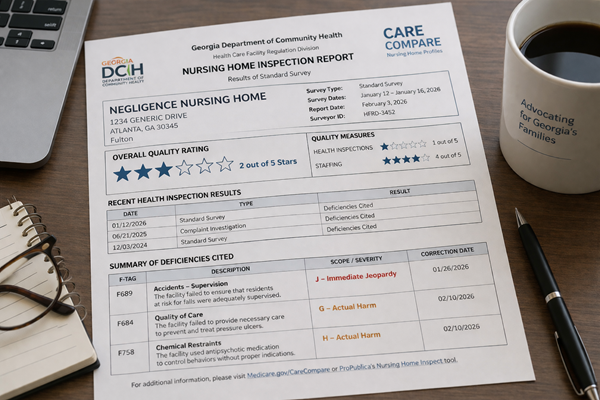
Most families choose a nursing home based on a friendly tour and a glossy brochure. What they rarely see is the inspection record, which is the only document that reveals how a facility operates when no one is watching.
In 2026, as Georgia’s senior population grows, understanding these reports is the most effective way to prevent nursing home abuse and neglect. You can access these records through Medicare’s Care Compare, the CMS Nursing Home Database, or ProPublica's Nursing Home Inspect tool. These reports don't just provide data; they provide a roadmap of a facility's failures before they become your family's tragedy.
Cracking the CMS Five-Star Code
The CMS Five-Star Quality Rating System is a quick snapshot, but the real story is in the details. A facility might have a high overall rating despite a poor Health Inspection score. At Johnson Greer Law Group, we tell families to look for these specific indicators:
- The Recent Trend: Newer inspections are weighted more heavily. A facility that was "Five Stars" three years ago but has plummeted recently is in a tailspin.
- Special Focus Facility (SFF): If a home has this designation, CMS has flagged it for a persistent history of serious quality problems. This is an immediate "no-go" for most families.
- The Staffing Ratio: Don't just look at the star; look at the hours per resident. Low staffing is the #1 predictor of neglect and falls.
Understanding Scope and Severity (A through L)
When a surveyor finds a violation, they assign it a letter grade from A to L based on Scope (how many residents are affected) and Severity (how much harm was caused). Here is how to translate the jargon:
- J, K, and L (Immediate Jeopardy): These are the most dangerous citations. They mean residents are at immediate risk of serious injury or death. A "J" rating is not a paperwork error; it is a life-threatening failure.
- G, H, and I (Actual Harm): This means a resident has already been hurt. Whether it’s a broken hip from an unsupervised fall or a stage IV pressure ulcer, "Actual Harm" is a major red flag.
- Substandard Quality of Care: This is a specific label for the most egregious repeated failures. If you see this, the facility is failing at its most basic mission.
A single J-level deficiency is not something a facility should be able to explain away with a brief conversation. It means a surveyor determined that residents were at risk of dying or being seriously injured because of something the facility was or wasn't doing.
The F-Tags That Matter Most
Every deficiency is tied to an "F-Tag." While there are hundreds, these are the ones that consistently point to institutional neglect:
- F689 (Accidents & Supervision): Look here for histories of falls, wandering, or elopement.
- F684 (Quality of Care): This covers everything from wound care to basic hygiene.
- F758 (Chemical Restraints): Cited when a home uses sedatives just to make residents "easier" to manage.
- F610 (Investigation): This shows whether the home actually investigates when a resident reports abuse.
- The Repeat Offender Rule: If you see the same F-Tag in two consecutive years, the facility's "Plan of Correction" was a lie. They didn't fix the problem; they just waited for the surveyor to leave.
What to Do With What You Find
Reading an inspection report is a starting point, not a conclusion. If you find concerning deficiencies, here's how to build on that information effectively. Review at least three consecutive inspection cycles, not just the most recent, because patterns become visible only over time. Pay particular attention to the relationship between the deficiency, the plan of correction the facility submitted, and whether the same issue was cited again in a later survey.
For families whose loved ones have already been injured, inspection records can serve as powerful evidence of a facility's history of negligence. A facility that has been cited three times for failing to supervise residents who are at wandering risk, and whose resident then suffers an elopement injury, is not facing an isolated incident. It's facing the predictable result of a pattern it was warned about and failed to correct.
Turning Reports Into Accountability
Inspection records are more than just a warning; they're powerful evidence. If your loved one was injured in a facility that has a documented history of the same F-Tag violation, that isn't an accident; it's systemic negligence.
Attorney George S. Johnson uses his 20+ years of experience—including time spent defending insurance companies—to turn these dense reports into a clear record of institutional failure. If you've found red flags in a report or your loved one has been harmed, contact us today for a free case evaluation. We know how to use these records to fight for the justice your family deserves.
“How can I start? They are great with advice, caring, informative, extremely detailed, and just overall great guys. I was going through some tough times, but both of them made everything smooth for me. If I could give them ten stars, I would. I would highly recommend them.” - R.F., ⭐⭐⭐⭐⭐